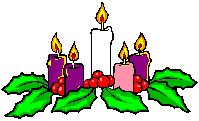
ADVENT WREATH
and FAMILY WORSHIP
 Advent, a season of the Christian year, is a time
of preparation for the birth of Christ. This includes
the four Sundays preceding December 25th,
often beginning with the Sunday following
Thanksgiving. Many families are rediscovering the use
of an Advent wreath in their homes for family worship.
Advent, a season of the Christian year, is a time
of preparation for the birth of Christ. This includes
the four Sundays preceding December 25th,
often beginning with the Sunday following
Thanksgiving. Many families are rediscovering the use
of an Advent wreath in their homes for family worship.
Like the Christmas tree, the Advent wreath is of
German origin, and probably had its beginning in pagan
customs. It’s use in America was mainly Lutheran
until the latter half of the 20th
century.
The simplest way to
prepare an Advent wreath is to use four small candle-holders (the
star-shaped glass ones are adequate) placed within or just
outside a circular wreath. If evergreens are used, they should be
changed often; the length of the candles should be watched
carefully to eliminate the danger of fire. Artificial wreaths of
plastic greenery often look lifelike and are safer. Styrofoam and
paper should be avoided in making and decorating the wreath since
both are flammable.
The only decoration
the wreath has (except for natural ornaments as pine cones and
holly berries) should be a purple bow, which symbolizes penance.
The entire Advent
wreath is rich in symbolism. The circular wreath stands for
eternity, and the evergreen is a symbol of eternal life. The
wreath is also an ancient symbol of victory and glory, and thus
symbolizes the reign of the coming King.
The colors of the
candles are also symbolic. Three of the candles are purple, the
traditional liturgical color for Advent. Purple stands for
penitence and preparation and thus is the color both for Advent
and Lent. But purple is also the traditional color of royalty and
reminds us during Advent that we are preparing for the coming of
our King.
The candle for the
third Sunday in Advent is pink and is called the joy candle.
(Some families and churches omit this custom and use purple
candles throughout the season.) A tall white candle, symbolizing
Christ, the Light of the world, is place in the very center of
the wreath.
Each Sunday of
Advent, one more of the outside candles is lighted, until on the
fourth Sunday all are burning. Then on Christmas Eve or Christmas
Day the Christ candle is lighted. The four outside candles are
replaced with new white candles, and these are lighted also.
These are then used each Sunday in Christmastide (December 25
– January 6).
The Christ candle
may be saved and used as an Easter candle, to be lighted each
Sunday during Eastertide (Easter Sunday and seven Sundays after.)
Families can write
their own brief worship service to use in connection with their
lighting of the candles on their Advent wreaths. A particular
theme can be assigned to each candle such as: the promise,
forgiveness, hope, love, peace, joy, etc. In the earlier days of
Advent, stress the darkness of the human condition for genuine
repentance and renewed commitment. Later, shift to anticipation
and celebration. Advent hymns, Christmas carols, and other hymns,
especially chosen for their meaning, may be sung.
Many families use
this opportunity to begin setting up a nativity scene. For the
first Sunday, they could place the empty stable. The second
Sunday, they could set out Mary and Joseph in the stable or place
them farther away, moving them closer each day.The third Sunday,
they could set the animals in place. By the fourth Sunday, the
shepherds could be put in position. On Christmas Eve, the babe
and manger should be placed in the stable. After Christmas, the
wise men could be started on their journey, arriving by the night
of January 5.
RESOURCE: The Light Shines in Darkness by Donald G. Shockley.
Below are links to suggested examples of family worship for the four Sundays of Advent and Christmas Day or Christmas Eve:
First Sunday
in Advent -
November 29, 2009
Second
Sunday in Advent
– December 6, 2009
Third
Sunday in Advent
– December 13, 2009
Fourth
Sunday in Advent
– December 20, 2009
Christmas
Eve or Christmas Morning
– December 25, 2009
Credits: Several paragraphs from the first Sunday were from the November 1976 issue of The Church School, P. 6, by Judith Woodward. All Bible passages were from the Revised Standard Version. Hymns were from the United Methodist Hymnal, 1989. The rest was penned by Pat Kelm, including lyrics to the new Advent song used for the fourth Sunday of Advent.
Back to Northland Notes or to Camp Sweat or Bob's Corner or perhaps Pat's Place and we also suggest Square Dances and maybe Contra Dances and then there's always Mixed Pics